21 October 2010

Decreased Average Loan Amount


As of the end of September 2010, the MAKAZI BORA program had disbursed a total of 379 home improvement loans and had 337 active clients. 81 home improvement loans were disbursed during the period of 1st July - 30th September 2010, with an average loan amount of 750,000 shillings (+/- $490). This average loan amount is slighlty lower than the previous average because MAKAZI BORA following some product feature changes in July. The maximum loan amount for first time borrowers was reduced from 1,500,000 shillings to 800,000 shillings. Repeat borrowers are now eligible for a maximum loan amount of 2,000,000 shillings for a second loan and 3,000,000 for a third loan. Most of MAKAZI BORA's active clients are still first time borrowers, resulting in the lower average.

In the first year of operations, the average loan period was consistently 16 months. With the decrease in the maximum loan amount for first time borrowers, the average loan period also decreased slightly in the last quarter to 14 months.

05 October 2010

New Home for MAKAZI BORA


MAKAZI BORA has a new home in Mbagala. The MAKAZI BORA office is now located on Kilwa Road across from the Rangi 3 Bus Terminal and above Akiba Commercial Bank. The new office gives MAKAZI BORA higher visibility and makes it more accessible to clients as promotion of the MAKAZI BORA home improvement loan continues in the Temeke Municipality of Dar es Salaam.

MAKAZI BORA has 362 active clients as at the end of September 2010. An update of our first year of operations has been posted as a link on side bar of this blog. Habitat for Humanity Tanzania is currently seeking capital to scale up its housing microfinance program in 2011.

28 November 2009

Costs to Client: Week 23 - 23rd - 27th November 2008


At the beginning of the week we were fortunate to have a visit from Sasi Thumuruli from Habitat for Humanity International. Sasi works with the International Housing Finance department and came for a brief visit after having worked with our colleagues at Habitat for Humanity Uganda, who operate a similar housing microfinance program. One of the key discussions we had during his visit was our loan process and the cost to our clients as they go through the process.

Before implementing the MAKAZI BORA housing microfinance program, we used Microfin software to plan and make projections. Microfin includes a component for determining the cost to the client when obtaining a loan. While planning and developing our processes, we were very conscious of how many trips to the office the client would have to make to obtain a MAKAZI BORA loan and then make payments. As things have evolved in practice, however, it seems as though clients are coming to the office much more frequently than originally intended. This is both as a result of process changes that did not effectively take the cost to the client into account, as well as the way in which credit officers have done their assessments and interacted with their clients in practice.

Each time the client comes to the office, it costs very little to Habitat for Humanity and may often reduce our institutional costs. However, it does represent a cost to the client. This cost is both in terms of the cost of transport to arrive at the office as well as the opportunity cost of being away from their income earning activities. The vast majority of our clients earn their livelihoods through the informal sector, so time spent at the office doing something related to their MAKAZI BORA home improvement loan is often time that they are not actively earning income. To provide good customer service, we wish to reduce the cost to client as much as possible.

We are currently working on streamlining some processes, which should streamline our work for both clients and credit officers and reduce costs to the client. We will review the process changes with credit officers and then likely implement some changes to the MAKAZI BORA loan process in January 2010.


21 November 2009

The Top Up Problem - Weeks 21 -22: 10th - 21st November 2009


Visit from Africa / Middle East Office
On the 10th - 14th November we were fortunate to have a visitor from Habitat for Humanity International's Africa / Middle East Area Office. Grace Sebageni, Housing Microfinance Coordinator for Habitat's work in Africa and the Middle East, made her first visit to the MAKAZI BORA program. She reviewed our work and conducted field visits to clients with two of the credit officers from the Mbagala Branch. Her visit was primarily an introductory visit, but we will be working with her closely in the future as we work in any needed revisions to the MAKAZI BORA program and product in view of scaling up our services next year and working towards achieving sustainability.

Low Number of Loan Disbursements:
Loans were disbursed during on 12th November, but two clients who had been approved for disbursement had travelled and have not yet received their loans. On the 21st, the Credit Committee approved an additional 21 loans, which are scheduled to be disbursed on 26th November. For the month of November, it appears that we will disburse less than 40 MAKAZI BORA home improvement loans. This is disappointing, because we had hoped and targeted to be disbursing approximately 50 loans per month by November. One challenge was the loss of a credit officer who resigned back in August, but some of the portfolios of the existing credit officers continue to show slower growth than expected. An additional credit officer will likely be needed to reach our annual target of 510 loans disbursed for the pilot period prior to seeking additional captial to scale up the program. We also continue to undertake promotion in newly added wards such as Makangarawe.

The Top Up Problem
Although we continue to be cautious about giving any glowing reports on portfolio health this early in the MAKAZI BORA pilot, so far repayment has been good. Some clients miss their payment, but then pay within a few days and pay a late penalty. So far, we have not had a client go an entire month without making any payment. The few problems we have so far are primarily due to partial payments, which result in the client still being considered late.

Partial payments can be for a number of reasons. Sometimes the clients rounds off the payment and forgets a few hundred shillings. In other cases the client miscalculates the late penalty (1% of total instalment per day late) when paying late. Clients pay directly to our bank account and bring the deposit slip to the office. This reduces the handling of cash and the risk of fraud, embezzlement or theft. The problem, however, comes when the client brings a deposit slip that is not a complete payment and must "top up" their payment. To date, we have been requiring them to return to the bank and make the additional deposit and return with the slip. Obviously, this is a hassle and cost to the client, especially given that the lines at the bank can be VERY long and it is sometimes to top up an amount of the equivalent of less than one US dollar. Not surprisingly, some clients leave the office to go to the bank and deposit their "top up" but don't return to the office on the same day. This leaves us with a partial payment that requires follow-up and added time and costs.

To mitigate this problem, we are considering accepting cash payments of "top ups" up to a small amount at the office and then banking them daily with registration fees collected. We have been trying to avoid cash payment as much as possible for internal control purposes, so it is still under consideration as we try to determine where the root of the problem is coming from and how to address it effectively.


07 November 2009

Small Housing Microfinance Loans: Week 20: 2nd - 6th November 2009


SMALLER LOAN AMOUNTS
This week the credit committee approved 17 new loans on Friday. The number of approved loans is still slightly below what we had hoped by week 20 of operations. We had hoped to reach over 150 loans with next week's disbursements, but we will not reach that many until the end of the month. One contributing factor was that the credit officer for Mbagala Kuu was on leave and therefore was not preparing files for submission and approval. Mbagala Kuu is the ward with the highest damand within our operating area, particularly the area of Mtoni Kijichi. It is an established settlement and tends to have people of slightly higher incomes than the other parts of the operating area. As a result, the loans from Mtoni Kijichi are often for the maximum loan amount and for activities such as connecting electricity or cosmetic activities such as putting in ceilings. Without clients from Mbagala Kuu appearing at this week's credit committee meeting, the average loan amount approved was much lower; an average of $594. Only two of the clients had loans for the maximum amount of 1,500,000 shillings.

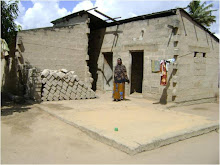
We are extremely happy with some of the types of loans approved this week. There are several loans for people who are extending their homes to add extra rooms. These are cases in which people built a larger house, but were only abel to roof and occupy part of it.


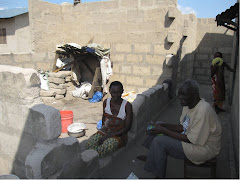
A MAKAZI BORA loan will make the entire house habitable

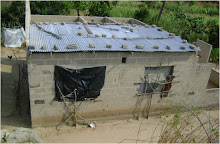
There were also several cases of people replacing old roofing sheets with new ones. In order to move into a house, it is not uncommon for people to utilize used roofing sheets to make the work more affordable. These are naturally more prone to leakage and several clients approved this are replacing old roofs with new ones.


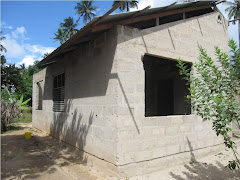
A loan for re-roofing will stop leaks

One client who is re-roofing and adding and extra room to his house raises chickens. He originally roofed with a flat roof made with used corrugatd metal sheets, but has since built up gables to make a new and better roof. He has a chicken business about 320 chickens at the moment and he raises them in one room of his small house. This poses both a health threat to the family and he also says that the room is too small for that number of chickens, so he can't expand his business. He says that when he re-roofs we will use the old roof to build a chicken coop outside of the house. He will simultaneously gain extra living space, have a healthier living enviornment and be able to increase his business. This is the kind of housing microfinance that we are proud to offer, as it is clearly making a tangible different in the household's living conditions.

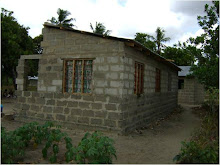
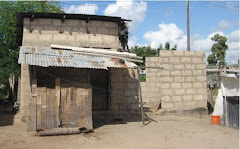
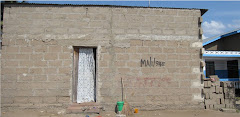
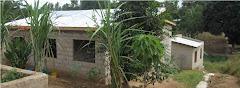
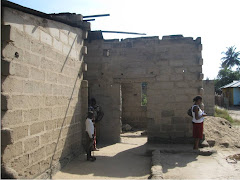
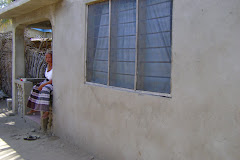
Last month another client applied to extend her house. We now have a policy that we don't give loans for constructing walls. We expect walls to be built before applying for the loan. This shows the commitment of the client to the home improvement project and prevents delays in completing the work after receiving a loan. (Block making and wall construction are some of the slowest aspects of construction.) The client had a foundation and some blocks, but was denied a loan because we required the walls to be built. She said she would come back to us  later and on Friday we reviewed her renewed application and approved it. She had built up the walls and is taking the loan for the roof, doors, windows and floor.


1st Loan Application - Rejected


2nd Loan Application - Approved
(The far left end of the extension was there previously and is an occupied part of the house.)

MAKANGARAWE EXPANSION
During the week promotional activities took place in the ward of Makangarawe. We have just expanded into Makangarawe, which is adjacent to Mbagala Ward. We hope that this will allow us to increase the number of loans approved per month by adding new potential clients. Because our MAKAZI BORA home improvement  loans a relatively small and the costs of assessing construction projects informally earned incomes is costly, a high volume of loans is needed to be sustainable.

30 October 2009

HMF Working Group - Week 19: 26th - 30th October 2009


ACTIVITIES DURING THE WEEK
The week opened with promotional activity on Monday. Boaz, Hamida Mwanga (Credit Officer) and I put up MAKAZI BORA posters at shops in Mzinga and Makwata in the Tuangoma Ward. Tuangoma is one of the wards in Hamida's portfolio and demand has been relatively low compared to other parts of the MAKAZI BORA operating area. Unlike previous promotional activities at Kongowe, we did not attempt to collect information on hardware dealers where we placed posters. We simply put up the posters, distributed brochures and spoke to the dealers and potential customers. This made the work go much smoother. The very act of putting up posters and talking to people as we did so seemed to generate some "buzz" in the area about MAKAZI BORA.


Only a few loans were disbursed this week (less than 10). We had hoped to make 50 loan disbursements during the month of October, but will fall slightly short of that target. We had also hoped to recruit an additional credit officer from two credit officer candidates who were trained in early June. The additional credit officer would be assigned to expansion into the Yombo Vituka and Makangarawe Wards. Unfortunately, neither of the trained credit officer candidates accepted the assignment. Boaz is considering expanding into Makangarawe (population +/- 50,000) with an existing credit officer.


HOUSING MICROFINANCE WORKING GROUP
On Thursday evening, Boaz and I met with representatives from the Community Centre for Initiatives (CCI), WAT Human Settlements and the Tanzania Gatsby Trust (TGT). It was an informal meeting to discuss what each organization is doing in terms of housing microfinance. We all have slightly different approaches to housing and housing microfinance, but we have similar objectives and there is potential for collaboration, sharing and learning. We hope to develop into a housing microfinance working group in the future to promote and housing microfinance in Tanzania.


All of the organizations at our informal meeting had attended a housing microfinance conference in Dar es Salaam in May of 2008 and are in the process of implementing or preparing to implement housing microfinance programs. Again, it is always a pleasure to be able to informally discuss housing and housing microfinance with people and organizations that share a similar passion.


24 October 2009

A Look at the Scenary - Week 18: 19th - 23rd October 2009


ACTIVITIES DURING THE WEEK:
The head office in Sinza was robbed this week. Thieves broke in on Monday night and took two safes, a bicycle and an old laptop computer. Fortunately, it appears that they were only after cash and did not touch the other computers and equipment. Although they carried the safes off with them, they apparently forced them open while still on the property, because they left us all of the documents and cheque books that had been inside. We are thankful for that!

We had several visitors during the week. A representative from the Bank of Tanzania (BOT) visited our offices to learn about our housing microfinance program. A World Bank funded program is being planned to offer support to the housing finance sector. We also had a visitor on behalf of FinMark Trust, doing research for a study on housing support services within housing microfinance. It is always a pleasure to talk to people who share similar interests in developing the affordable housing finance sector.

On Friday the credit committee met to review applications. Several applications were rejected or returned to the credit officers for further work due to what appeared to be inflated budgets for the proposed work or inconsistencies in the proposed home improvement project. 10 clients had their applications approved for disbursement next week.


A LOOK AT THE SCENARY:
A credit officer making an assessment visit in the area called Kibonde Maji (Charambe Ward) looked out from the plot of the client she was visiting and took a few photos. The photos give a sense of what an expanding informal settlement looks like, with a variety of types of houses at different levels of construction and completedness.

In the photo below, you can see several houses built to roofing level, but not yet roofed. This type of house would be categorized as a completion if it were to receive a MAKAZI BORA home improvement loan for roofing, doors and windows. On the left-hand side slightly up from the bottom of the photograph, there is a house being extended. The extension has not yet reached roofing level. Another house appears in the process of being roofed, with one sheet missing. To the left of and slightly below the almost-roofed house is a is a small house with "teeth" extending from it that has obviously been built in view of extending it later. One house (behind the one with the red roof) looks as though it might have been constructed with previously used roofing sheets. To the right of that house is a two-roomed house that has one room roofed and occupied and the other built to roofing level but not yet roofed.


The photo below is taken from the same location, but looking in a slightly different direction. The first thing of note is apparent income disparity of the dwellers. The house in the foreground has a satelite dish, is painted, has facia board and shuttered windows, which seems to denote a higher income than that of the neighbours. Informal settlements are not homogenous in terms of the income levels of the people who live there.

A small house in the center left appears to be build for extension forward. In front of the house is a plastic structure that is a latrine or bath. Latrines are also visible slightly up the hill, one made of blocks and unroofed with a cloth door and the other made of plastic covering on a stick frame.  In the middle of the photo is a fairly large structure that only has one small room roofed. It may be occupied by the owner, but it might also be someone hired or allowed to stay there to guard the property against encroachment. Next to that on the right is a small, but fairly well completed house, with some blocks saved next to it. The windows, however, appear as though they may be of temporary materials.  In-kind saving of materials can be seen above that house on a plot in the upper right-hand corner. There is some sand in a pile surrounded by blocks to proteck against run-off and some blocks stacked nearby. In fact, there appear to be blocks saved on at least three plots across that level of the hill.

Below are other houses in various states of construction. The houses at the top of the hill on the upper right seem to be older and more established. They may have been the first to settle in the area, while others who came later accessed plots further down the slop of the hill.

The photo used as the banner for this posting is from the same area. The cropped version below shows two small one-roomed houses that appear to be designed for expansion by building another room in between. This is an unusual method of extending, as extension is usually off the side of the house or extending forward or backward. (Verticle extension is not common among low income households in Dar es Salaam.)


None of the houses in the photographs belong to MAKAZI BORA clients. They are the view from the house of one of our clients and clearly show the environment in which we work.