19 August 2009

Loan Use Verification


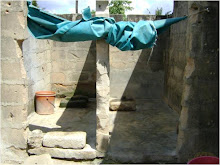
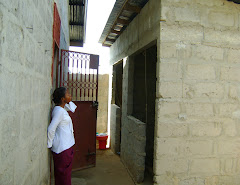
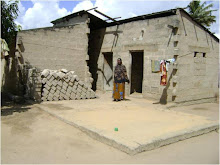
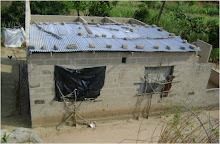
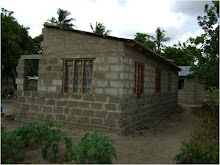
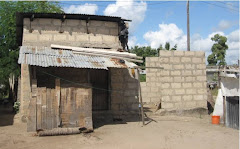
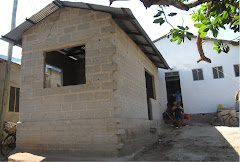
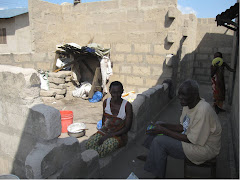
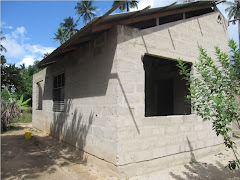
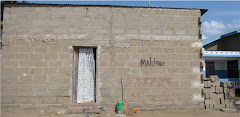
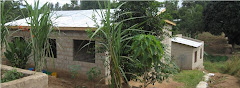
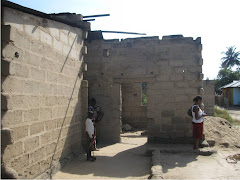
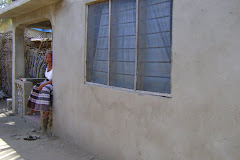
Above are some of pictures showing house projects before and after loan.


Last week, we started verifying loans to determine if were used for intended purposes. Four loans were scheduled for verification during the week. The loan verification is done by a different credit officer from one promoted the loan. The verification results were good, though one client didn’t complete his project in the given time, hence his loan was declared diverted. The other three borrowers completed their projects as indicated in their loan proposals. Three loans that passed verification were discounted from paying 5% interest per month to 2.5 % per month

Interestingly one client came to our office to ask her loan to be verified before her due date. This happened because the client wanted to travel outside Dar, she wanted to make payment before she left. However, there were some problems for clients who took loan for electricity connection. Although, all of them paid connection fee but the power company could not install electricity on time.

07 August 2009

The Discount Principle at Work: Week 7: 3rd - 7th August 2009

During week 7 of operations, 8 new loans were disbursed, bringing the total active loans to 29. 2 additional loans have been approved and processed, but have not yet been disbursed. One of the clients traveled out of town and the other is still preparing the security deposit and loan insurance payment that must be made prior to disbursement. The credit committee approved 8 loans for disbursement next week.


1 application was not approved by the credit committee due to an issue related to ownership of the plot of land on which the house is located. The plot belonged to the client's late father and has been inherited by the children. There is documentation showing the transfer of title through inheritance, but the title is in the name of the sister of the client, who is married and lives with her family at another location. Property related to inheritance can cause problems and family disputes which could pose a risk to the loan. Had the sister been a guarantor for the loan, we probably would have approved the application. (The application was otherwise acceptable.) In the end, we returned the client's file to the credit officer and asked for a letter from the sister stamped by local government officials and acknowledging that she approves of the work to be done on the house by the client. With that letter, we would feel secure enough to approve the loan at a future credit committee sitting.


The first group of clients who had their loans disbursed in July are in the process of finishing their home improvements. To ensure that MAKAZI BORA loans are used for housing purposes, loans are disbursed at a higher than market interest rate. Prior to disbursement, pre-loan photos are taken of the house and specific parts of the house on which the home improvement is to be done. The client and the credit officer agree on exactly what work is expected with the loan. Within 30 days after disbursement, another credit officer visits the site to see if the work has been completed and takes post-loan photos. If the work was completed according to plan, the interest rate is discounted significantly.


Clients understand the discount principle well. Some of the first group of clients that had their loans disbursed in July have been calling the office to have their loan use verified. They say that they do not want the repayment schedule upon which the loan was disbursed, but want to redeem it to receive a new repayment schedule with the discounted interest rate. That is the whole objective of the mechanism and it should help ensure that Habitat's housing microfinance program results in home improvements.


One client came to the office to ask for leniency on the loan verification process. He received a loan for connecting electricity, but there were some complications from TANESCO (Tanzania Electric Supply Corporation) and the work has not yet been completed. He realizes that his loan may be classified as a diverted loan, because the indicator for verified loan use was that there is electricity in the house. After discussion, we decided not allow leniency in loan use verification, because there are always likely to be various delays, etc., which can quickly give room to excuses for non-completion of work and the collapse of the two-tiered interest rate system that is designed to ensure loans are applied to home improvement purposes. We may give an option of having a second verification after 6 months and adjusting the loan at that time for those who were unable to comply with the initial verification. We want to be fair, while ensuring that the home improvement has been made with the loan.


Promotion started in the wards of Azimio and Mtoni. Because the cost of lending is high and the margin of revenue earned on each loan is very small, the MAKAZI BORA housing microfinance program can only break even and become sustainable by achieving volume. Credit officers who have not had many clients to date are having their operating areas expanded and spending more time in the field on promotion. An additional promotional campaign will start in September, which may include MAKAZI BORA posters at hardware dealers and other strategic locations.


Client businesses have proved interesting. One client provides food for a workers cashew nut processing factory in the area. Several sell kitenge (African cloth worn primarily by women) on credit. Some sell pre-paid cell phone cards, both retail and wholesale. Many have businesses that are located at or near their homes.


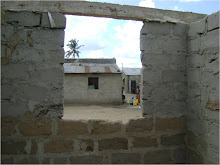
HOME BASED BUSINESS: Looking out from a window that one client wishes to repair as part of the work with a MAKAZI BORA loan, one of the client's businesses is visible just outside. The client also sells charcoal from another location. Many clients have multiple small businesses, which increases income and adds security to their household income. (Don't put all your eggs in one basket.)

31 July 2009

First Full Month's Status - Week 6: 27th - 31st July

July was our first full month of operations. As at the close of the month we have nearly 90 clients registered and disbursed 21 MAKAZI BORA home improvement loans. We also tested "a manage your own construction" workshop on the 31st. The credit committee sat on the 31st and approved 9 loans for disbursement during the first week in August.

At at the close of July:

  • 11 of the active clients are men and 10 are women.


  • The average loan amount is 930,952 shillings (+ / - $690)


  • The most common loan use is "finishing" (new work done on a house that is occupied). This corresponds to a type of incremental building in which the dweller completes a house to the bare minimum they require for occupation and then slowly finish it as the live inside. 9 out of 21 loans were for this purpose.


  • 6 loans for were "completions" (work on a new house that is not yet occuied), 3 loans were repairs, 2 were auxiliary structures and 1 was an extension.


  • 7 loans were disbursed to clients living in Mbagala Kuu Ward, 6 in Charambe, 3 each in Mbagala and Chamazi and 2 in Tuangoma.

Although there is still some question on the accuracy of some of the income assessments (clients appear to be overstating their income and understating expense), 2 clients have a per capita household income of the equivalent of $1.01 - $2.00 per month, 5 fall in the $2.01 - $3.00 per capita range, 5 at $3.01 - $5.00 per capita and 9 over $5.00. Although some of the last category of over $5.00 per capita per day household income certainly have lower incomes, the first month's disbursements had nearly 50% of clients with incomes our target group. We will continue to monitor this and continue to try to improve the accuracy of our income assessments.

Irene Assey and Osnery Chankumpa review a file during a credit committee meeting.


Dorica Fungo, Construction Techncial Assistance intern, presents a workshop and booklet on managing your own construction process.

30 July 2009

Rejected Loan Applications - Week 5: 20th - 24th July 2009

Minor adjustments continued to be made to various forms, such as the introduction of the client number into the loan agreement. Credit officers began using feedback forms with their clients. No official complaints have been lodged by clients yet, but these will certainly come eventually. A suggestion box was put on the veranda of the office as per one means for feedback that was communicated to clients in their welcome packets.

Mbagala Branch Office with the new suggestion box next to the door on the right.


Several loans were rejected by the credit committee. One was because of lack of a visible project. The client wanted to extend his house and build a wall, but the proposed project started with the purchase of blocks and there was no visible work done at all. He might have used the loan as intended, but we believed that it was at high risk of diversion and recommended that he advance his project first. We are sticking by a decision not to have the purchase of blocks as part of the loan for completions, extensions and auxiliary structures. These are commonly collected as in-kind savings and it is reasonable to expect the clients to advance their project to wall plate level prior to the introduction of a home improvement loan.


Another loan was rejected due to over-indebtedness. The client could afford the MAKAZI BORA loan according to our calculations, but he had an outstanding loan with a bank. The two loans together would have required monthly payments exceeding 60% of his gross income. This was too risky for Habitat and also too much strain on the household and was rejected. We advised him to apply again after paying off his bank loan if he still desires the MAKAZI BORA loan.


The only handheld GPS unit had been used by interns mapping construction support services in the operational area. With their work finished, the GPS unit was used to record the position of clients' houses for the first time. These will be entered into a Google Earth satelite photo of the area to allow us to identify the location of our clients and study any patterns in loan distribution.


The portfolio for Mbagala Ward is not resultng in many clients, despite its high density. It is a fairly well-established settlement with minimal construction activity. We decided to add Azimio Ward to the Mbagala Credit Officer's portfolio starting the following week.
Magdelena was the first credit officer to use the GPS unit to record the position of a house in Chamazi during a loan assessment.

29 July 2009

First Disbursements Made - Week 4: 13th - 17th July 2009


Glory at her desk with her MAKAZI BORA work tools: calculator, credit officer's guide to loan cost, brochures, phone and client files.

The first three MAKAZI BORA loans were disbursed, giving a portfolio of 3 million shillings. The average loan amount for the first set of disbursements was 1,000,000 shillings (+/- $740). All three loans were in the loan use category of “completion,” being for completion of an unoccupied structure. Information was obtained that the loan that was rejected outright the previous week because it lacked a visibly active home improvement project was the husband of a defaulter from the previous Habitat program. Rejecting the application appears to have been the right thing to do, as it was likely to have been a bad loan.


Credit Officers were verbally reporting some comments made by clients, but there were not complaint or feedback forms documenting them. The system is not yet functional and credit officers were encouraged to use the complaint forms as per procedure when any registered client has something to say. The credit officer can fill it out and have the client sign it.


There were a number of guarantors from the first loans that now want to apply themselves. This is against policy and the guarantor form (in Kiswahili) clearly states that guarantors of an active loan cannot apply for a loan themselves until the loan they are guaranteeing is paid off. We almost had a circle of clients guaranteeing each other, but stood firm on the policy. If a guarantor wants a loan, the client for whom he or she is guaranteeing should get a suitable replacement and remove the guarantor – or the guarantor can wait.


During the first credit committee meeting, it became apparent the income assessment was not rigorous. It looked as if the credit officers were just writing down whatever the clients said. We had asked them to provide notes on how they calculated income and expense, but these were still not sufficient. We will begin to make worksheets for calculating income for different types of businesses based on the nature of the business. If the client is a charcoal seller, the credit officer will use the charcoal seller worksheet, etc.


I (Scott) appear to have been the first person to violate the Client Principles. In our Habitat for Humanity Tanzania newsletter, I put a few very brief profiles of homeowners to demonstrate the types of home improvements we will be supporting and the types of clients. I included a photo of clients and the approximate loan amount. It seemed to me afterwards, however, that this is a violation of our client principles of dignity and protection of client information. Maybe the client doesn’t want people knowing the size of his or her loan! This was a mistake. As a result, we decided to make some changes to our application form, which is the only form that had been in English. We translated it into Kiswahili and put in a section in which the clients could indicate whether we have permission to use their photos for promotional or reporting purposes. We will just have to remember to check on the files before using clients photos, including in MAKAZI BORA DIARY!

First Clients Approved - Week 3: 6th - 10th July 2009

The number of information sessions decreased significantly this week, down to 57. Only 9 new clients were registered. After peer review by the credit officers, 5 applications were passed on to a credit committee for approval. The committee currently consists of the National Director, Program Manager, Administrative Assistance and Accountant. The composition will change as the organization develops and there are more layers of staff.

Only 3 of the applications were approved. One was sent back to the credit officer because it did not have sufficient collateral and guarantees. The client’s proposed loan amount was close to our upper level of affordability, but was still within the limits. We returned the application to the credit officer to have the client find a guarantor to guarantee the difference between her chattel and the exposed loan amount and then resubmit because it was otherwise acceptable.


The rejected application was for repairing cracks in a wall, putting in a ceiling and building a kitchen. This application was the subject of much discussion. First, the cracks were a symptom of a larger problem. We would have like to have a report on how the builder assessed and proposed to fix the root cause of the cracks rather than just fill them. Secondly, we didn’t see any evidence of a viable project in terms of a kitchen or ceiling project. We looked at pre-loan photos and there were no blocks saved, no foundation or walls built and no other evidence of a home improvement in progress. It gave every indication of someone who heard about a loan and came to apply even though he was not actually engaging in an active home improvement plan. This seemed like a high risk for loan diversion and was rejected outright.


Now having approved clients, we wished we had some kind of form or invoice to inform the clients that they had been approved, should come and sign loan agreements and make specific payments into our bank account for the loan insurance and security deposit. This was an oversight when we were developing forms. An offer letter was developed. It once again explains the terms of the loan and gives instructions to the client for depositing the security deposit and insurance payment. As we get ready for our first disbursements next week, we met with the bank manager where our checks to clients will be cashed to ensure that we are on the same page about the procedure so that the clients do not have any problems. Clients will present their ID cards when they cash their checks and the client numbers will be written on the checks.
"Our Neighbourhood:" The view from the Mbagala Branch Office's front porch. To the far left is a restaurant, followed by a donought seller, fruit stand, a video parlor (cinema), general shop and phone dealer.

Volunteer Promoters - Week 2: 25th June - 3rd July 2009

93 people came in during the week and 16 new clients were registered. There seem to be a lot of clients coming from Charambe, which is an expanding informal settlement in which the office is located. Mbagala and Tuangoma have had the fewest registered clients. Mbagala is an established informal settlement that our interns working on a construction technical assistance survey indicate has limited construction activity taking place. If there is insufficient demand in Mbagala, we may expand the portfolio of the Mbagala credit officer’s to include a second, adjoining ward. Tuangoma has also had few registrations. It is a predominantly rural ward.

We have noticed that continued prevalence of “volunteer promoters” coming back with friends. Client relations should continue to be a focus. We have client principles and if we can implement them well we hope that the number of clients giving positive promotion about MAKAZI BORA will outnumber those who have complaints or bad things to say to their neighbours. Our client principles in summary are:


  • Quality of Service


  • Dignified Treatment


  • Truthful and Transparent Information


  • Appropriate Pricing


  • Protection from Unethical and Illegal Practices


  • Privacy of Client Information.

5 clients had their applications assessed during the week; their applications to go through peer review the following Monday. We ran out of our 2,000 MAKAZI BORA brochures and need to order more.


Scott next to our Client Principles at the Mbagala Branch Office. The principles and a promise to our clients are translated into Kiswahili and part of the clients' welcome packet.